
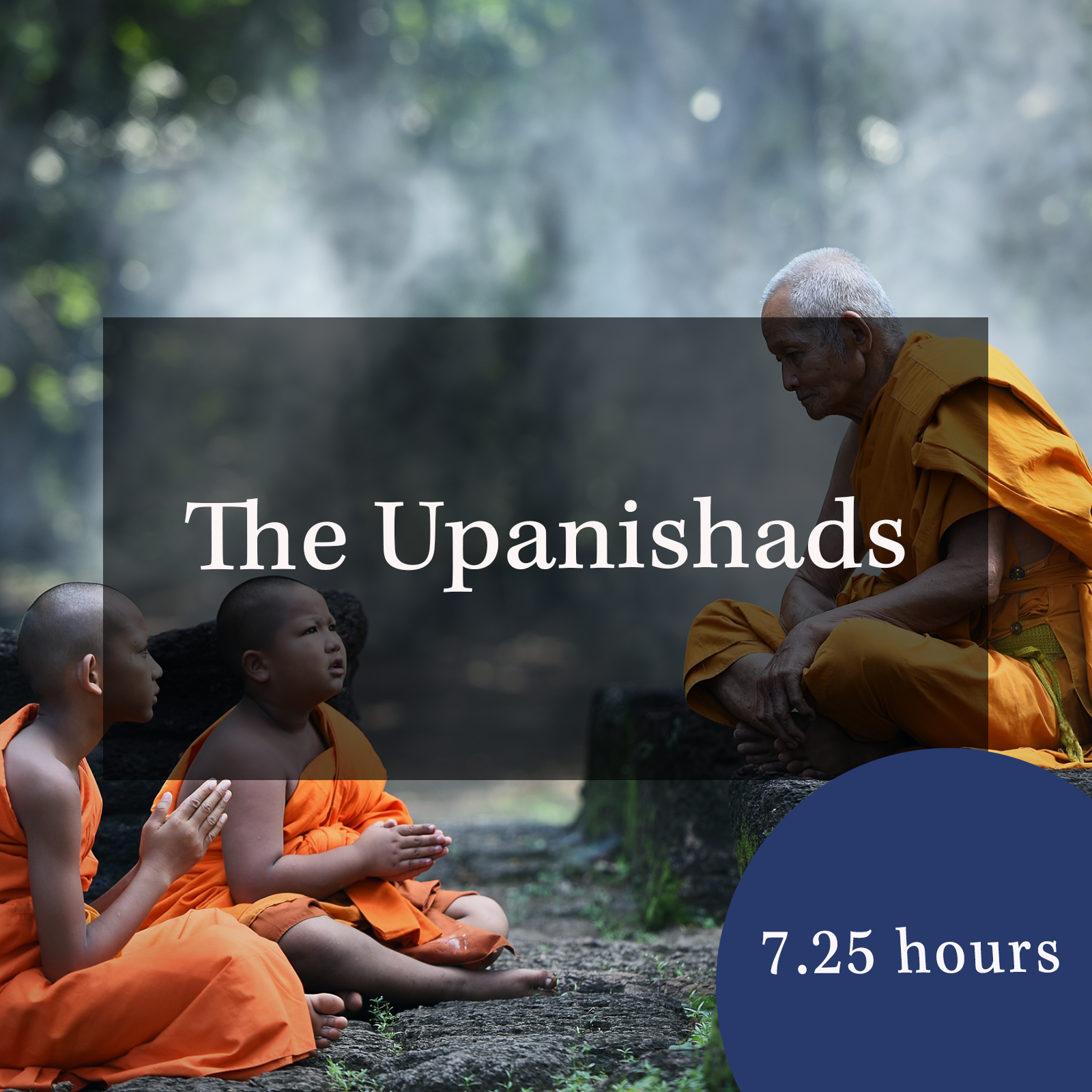
Take your students on an tour through the key lessons of the Upanishads! Through these lessons, you will provide historical context and illuminate key concepts from select readings that will help students to develop a greater awareness of yoga history and its evolution. Guided reflections and discussions help to bring these philosophical ideas to life and make them relevant for the modern world. This lesson plan on the Upanishads helps you teach yoga philosophy with more clarity, structure, and confidence.
Where It Fits
- Best used in the philosophy portion of a 200 or 300 hour yoga teacher training
- May be used for continuing education offerings
Why Use Ready-Made Lesson Plans
- Creating a teacher training from scratch can take hundreds of hours
- High-quality lesson plans help studios and trainers:
- Save months of curriculum development
- Focus on editing/adaptation rather than building a program from scratch
- Access best educational practices to optimize student-centered learning
- Ensure topics build logically and progressively across modules
- “Bulletproof” your training from faculty absence/change; creates program consistency even with multiple trainers
- Maintain clarity on IP/program ownership
- Launch a program more quickly
- More easily register with key professional organizations, such as Yoga Alliance or the American Yoga Council
How Studios Use These Lesson Plans
Studios typically use these materials to:
- Launch a new 200-hour or 300-hour yoga teacher training
- Supplement an existing curriculum
- Support guest faculty teaching
- Maintain consistent teaching quality across cohorts
Detailed Overview and Learning Objectives
By the end of this lesson, your students will be able to:
Part 1 (Overview): 75 min
- Describe the historical context for the Upanishads (general time period, cultural context)
- Describe the relationship of the Upanishads to the Vedas and Vedic tradition
- Define “shramana”
- Translate “Upanishad” and the its significance to the tradition
- Identify two Mahavakyas
Part 2 (Brihadaranyaka and Chandogya Upanishad): 90 min
- Describe how the process of “neti, neti” may serve to illuminate the true Self
- Describe how the stories of the Brihadaranyaka Upanishad serve to show flexibility in the traditional caste and gender roles, as well as illuminate the principles of studentship
- Define non-dualism and describe its relationship to the spiritual insights of the Upanishads
- Describe how the stories of the Chandogya Upanishad illuminate the guru student relationship and define the true nature of the Self
Part 3 (Chandogya, Taittiriya, and Mandukya Upanishad): 90 min
- Describe the five koshas
- Describe the five vayus and their movements
- Describe how is the Vedic “om” different from the Upanishad “om
- Describe the significance of the 4 parts of OM
Part 4 (Katha Upanishad): 90 min
- Describe the significance of the story of Nachiketa
- Identify three key qualities of worthy student
- Contrast the “good,” vs. “the pleasant”
- Identify one’s own distractions, and identify support strategies to remain mindful
- Retell the Chariot story, identifying its metaphorical significance
Part 5 (Mundaka and Svetasvatara Upanishad): 90 min
- Describe why Samkhya philosophy would be considered dual rather than non-dual
- Describe what the two birds on the branch represent
- Describe the difference between yoga and Samkhya philosophy
- Describe how the Svetasvatara Upanishad represents an attempt to reconcile Samkhya philosophy with emerging theism
- Review key stories of the Upanishads and identify their primary ideas
What You Need
- Students should have a copy of the text by their translator of your choice
About Rachel
Rachel Scott is a yoga educator and teacher trainer with who has been leading YTT’s since 2008. Holding a Master of Science in Instructional Systems and Learning Technology, she blends real world experience with academic integrity to design structured, high-quality curriculum for yoga teachers and studios. Her lesson plans are used by yoga teacher trainers around the world to support clear, engaging educational experiences for trainees.
Testimonials
- “Working with Rachel was the best investment I could have made-both for myself and my students! The excellence of her product provides an intelligent easeful structure that allows me freedom to focus on what I love about teaching rather than being buried in logistics. Rachel takes time and intention to work with you the entire way and was more than gracious with my many questions. From the daunting process of the YA application to the hourly logistics of our weekend layout, Rachel’s expertise and guidance have not only saved me hundreds of hours of administrative work but have helped me feel confident in the program I am offering while still getting to incorporate my own voice, language, and style. Thank you Rachel for all the work you’ve done and how generously you share it!!” – Giuliana D.
- “Professional, detailed, and thoughtful.” – Kanami A.
FAQ
Can I edit the material?
- Absolutely! The materials are provided in Google Slides (when applicable) and Google Docs.
- You can copy the materials into your own Google Drive or download and edit and make them to make them your own.
Can I use this in my own teacher training?
- Yes! These lessons are designed for use in yoga teacher trainings.
How does the copyright work?
- All original copyright stays with me and you have permission to use and edit these materials for your own educational programs.
- The limitation on use is that you can’t re-sell the materials or transfer their use to someone else.
Does this material align with Yoga Alliance requirements?
- Yes, my lesson plans and materials have been used in hundreds of successful Yoga Alliance (and other governing body) submissions.
What do I need as teacher trainer to present the lessons?
- All anatomy lessons and some philosophy lessons contain a visually rich presentations, which require a projector and computer.
- Some lesson plans benefit from having a whiteboard or poster sheets available.
- For anatomy lessons, I recommend having a skeleton, though it’s not required.
Can I buy a whole 200 or 300 hour program?
Yes! Purchasing the curriculum as a program will:
- Save you money versus purchasing a la carte
- Give you access to robust student assessments
- Include a custom built training schedule
- Access to coaching for Yoga Alliance or American Yoga Council registration and consulting
Do I get materials immediately?
- Because I want you to have my most recent and update files, I will personally email you the links to your lesson plans within 48 hours of your purchase.
Are there recurring fees?
- No ~ I want you to take these lesson plans and make them your own!

Secure checkout on my course platform.



Reviews
There are no reviews yet.